The Irish Cup
The Irish Cup is the leading knockout cup competition in Northern Irish football and the fourth-oldest national football cup competition in the world.
First contested during the 1880/81 season, the tournament is organised by the Irish Football Association and is open to eligible senior, intermediate and regional clubs from across Northern Ireland.
The competition is officially known as the Irish Football Association Challenge Cup, although it is almost universally referred to as the Irish Cup. Under its current sponsorship agreement, it is called the Clearer Water Irish Cup.
The final is traditionally played at the National Football Stadium at Windsor Park in Belfast. In addition to lifting one of the oldest trophies in world football, the winners normally secure a place in the qualifying rounds of the UEFA Conference League.
Origins and History
The Irish Football Association was founded in Belfast on 18 November 1880.
Representatives from Cliftonville, Avoniel, Distillery, Knock, Oldpark, Moyola Park and Alexander met at the Queen’s Hotel with the intention of creating a governing body for football in Ireland.
The new association quickly established a knockout competition modelled partly on those already being played in England, Scotland and Wales.
The first Irish Cup was held during the 1880/81 season. Moyola Park became the inaugural winners by defeating Cliftonville 1-0 on 9 April 1881.
The competition was originally played by clubs from across the island of Ireland. Teams from Belfast dominated many of the early tournaments, but clubs from Dublin and other parts of Ireland also participated.
Following the creation of a separate football association in Dublin in 1921, the Irish Cup gradually became the principal knockout competition for clubs affiliated with the Belfast-based Irish Football Association.
The corresponding national cup competition in the Republic of Ireland is the FAI Cup.
Why Is It Still Called the Irish Cup?
The name can occasionally cause confusion because the competition is now associated with Northern Irish football.
When the tournament began in 1881, the Irish Football Association governed football throughout the island. The competition was therefore established simply as the Irish Cup.
After football administration divided in the early 1920s, the Irish Football Association continued to organise the original tournament. The Irish Cup name was retained because of the competition’s history and established identity.
The cup competition organised by the Football Association of Ireland in the Republic of Ireland is called the FAI Cup.
Some clubs currently associated with football in the Republic appeared in early Irish Cup competitions. Bohemians and Shelbourne were among the Dublin clubs to reach or win finals before the division of football administration.
The Irish Cup should therefore not be renamed retrospectively as the Northern Irish Cup. Its existing name reflects its origins as an all-island competition.
The Clearer Water Irish Cup Name
The permanent name of the tournament is the Irish Cup, but sponsorship agreements have resulted in several commercial names being used.
Previous sponsors have included Bass, Nationwide, JJB Sports, Tennent’s and Samuel Gelston’s Whiskey.
The competition is currently sponsored by Clearer Water and is therefore known as the Clearer Water Irish Cup.
The final is usually played at the National Football Stadium at Windsor Park, which is presently sponsored separately as the Clearer Twist National Stadium.
These commercial names may change, but the Irish Cup remains the most recognisable and useful permanent name for the competition.
Who Enters the Irish Cup?
The Irish Cup is open to eligible clubs affiliated with the Irish Football Association.
Entrants come from several levels of the Northern Irish football system, including:
- The NIFL Premiership
- The NIFL Championship
- Intermediate football
- The Northern Amateur Football League
- Regional intermediate leagues
- Other eligible affiliated competitions
Clubs enter at different stages according to their playing status.
Regional and intermediate teams begin in the early rounds. Leading senior clubs join later, giving smaller teams an opportunity to progress before facing Premiership and Championship opposition.
This arrangement creates the possibility of genuine cup upsets. A community or intermediate club can earn a home tie against one of Northern Ireland’s leading teams, potentially attracting a large crowd and valuable additional income.
How Does the Irish Cup Work?
The Irish Cup is played as a straight knockout competition.
Each tie consists of a single match, with one club drawn at home and the other away.
If a match is level after 90 minutes, extra time is played. A penalty shootout decides the winner if the scores remain level after extra time.
Replays were once a regular part of the competition, including in finals, but they are no longer used in the current format.
The semi-finals are normally played at neutral venues. In recent seasons, the National Football Stadium at Windsor Park has hosted both semi-finals as well as the final.
The competition begins during the summer and continues throughout the season, with the final traditionally staged at the beginning of May.
The 2026/27 Competition
A total of 126 clubs entered the 2026/27 Clearer Water Irish Cup.
The Irish FA introduced a revised structure for the season.
Regional intermediate clubs entered in Round One, while Northern Amateur Football League National Conference clubs joined in Round Two. Senior clubs will enter in Round Six.
The scheduled dates are:
- Round One: 8 August 2026
- Round Two: 12 September 2026
- Round Three: 24 October 2026
- Round Four: 21 November 2026
- Round Five: 5 December 2026
- Round Six: 8 and 9 January 2027
- Round Seven: 12 and 13 February 2027
- Quarter-finals: 12 and 13 March 2027
- Semi-finals: 2 and 3 April 2027
- Final: 1 May 2027
The First Round consisted of 34 ties, with 18 clubs receiving byes. The successful teams are joined in Round Two by 12 clubs from the National Conference League.
A new competition rule also gives the Irish FA the option to introduce Football Video Support during the later stages. Any decision to use the system must be communicated to the participating clubs in advance.
The Irish Cup Final
The Irish Cup final is one of the biggest occasions in the Northern Irish domestic football calendar.
It is normally played at the National Football Stadium at Windsor Park in Belfast, which is also the home of the Northern Ireland national team and Linfield Football Club.
The stadium has staged the majority of recent finals, although other Belfast grounds have been used throughout the competition’s history.
Earlier finals were played at venues including Solitude, Grosvenor Park, Celtic Park, The Oval and Ballynafeigh.
The modern final is generally held on the first Saturday in May. It attracts supporters from across Northern Ireland and is broadcast on television and online.
For clubs outside Belfast, reaching the National Stadium can become one of the most important occasions in their history.
Most Successful Clubs
Linfield are by far the most successful club in Irish Cup history.
The Belfast club have won the trophy 44 times and finished as runners-up on a further 22 occasions.
Linfield’s first victory came in 1891, when they defeated Ulster 4-2 at Solitude. They went on to establish a level of cup dominance unmatched anywhere else in Northern Irish football.
Other leading winners include:
- Glentoran, 23 wins
- Lisburn Distillery, 12 wins
- Cliftonville, nine wins
- Belfast Celtic, eight wins
- Coleraine, seven wins
- Glenavon, seven wins
- Crusaders, six wins
Belfast clubs have won the majority of Irish Cup competitions, but the trophy has also travelled to towns including Coleraine, Lurgan, Ballymena, Portadown, Carrickfergus and Dungannon.
The variety of recent winners demonstrates that the competition remains more open than its overall historical record might suggest.
Memorable Irish Cup Finals
The Irish Cup has produced numerous dramatic finals, record scorelines and unexpected winners.
Moyola Park 1-0 Cliftonville, 1881
Moyola Park became the first Irish Cup winners by defeating Cliftonville in the inaugural final.
The club came from Castledawson in County Londonderry and had been one of the founding members of the Irish Football Association.
Linfield 10-1 Bohemians, 1895
Linfield recorded the largest winning margin in Irish Cup final history when they defeated Dublin club Bohemians 10-1.
The result came during a period in which clubs from across Ireland competed in the tournament.
Carrick Rangers 2-1 Linfield, 1976
Carrick Rangers produced one of the greatest shocks in the competition’s history by defeating Linfield in the 1976 final.
Carrick were an intermediate club at the time and became one of the few teams from outside senior football to lift the trophy.
The victory also earned the club an opportunity to compete in the European Cup Winners’ Cup.
Cliftonville 3-1 Linfield, 2024
Cliftonville ended a 45-year wait for Irish Cup success by defeating Linfield after extra time.
Sam Ashford scored during normal time before Ronan Hale struck twice in extra time to secure the club’s ninth Irish Cup.
Remarkably, despite their long and successful histories, it was the first time in 90 years that Cliftonville and Linfield had met in the final.
Dungannon Swifts Win for the First Time
Dungannon Swifts lifted the Irish Cup for the first time in 2025.
Their final against Cliftonville finished level after extra time before Dungannon won the penalty shootout.
The victory was one of the greatest achievements in the club’s history and secured European football for the following season.
Current Holders
Coleraine are the current Irish Cup holders.
The Bannsiders defeated Dungannon Swifts 3-2 in the 2025/26 final at the National Football Stadium on 2 May 2026.
Matthew Shevlin scored twice for Coleraine, with Joel Cooper adding their other goal. Paul Doyle and Andrew Mitchell scored for Dungannon.
Coleraine took a two-goal lead before Dungannon pulled one back. Shevlin restored the two-goal advantage, but Dungannon responded again to set up a tense finish.
Coleraine managed the closing stages effectively and held on in front of a crowd of 11,362.
It was the seventh Irish Cup victory in the club’s history and their first since 2018.
Dungannon had been attempting to retain the trophy following their first victory in 2025. They would have become the first club from outside Belfast to win consecutive Irish Cups.
European Qualification
The Irish Cup winners normally qualify for the UEFA Conference League.
The exact point of entry depends upon Northern Ireland’s UEFA coefficient, the current European access list and any changes to UEFA’s competition structure.
The winning club must also obtain the appropriate UEFA licence. If the cup winners do not satisfy the licensing requirements, their European place may be reassigned under Irish FA and UEFA regulations.
Coleraine’s 2026 victory placed them in the second qualifying round of the 2026/27 UEFA Conference League, where they were drawn against Finnish club HJK Helsinki.
Before the creation of the UEFA Conference League, Irish Cup winners competed in the UEFA Europa League or its qualifying rounds.
Earlier winners represented Northern Ireland in the European Cup Winners’ Cup. That competition operated from 1960 until 1999 and produced a number of memorable European nights for Irish Cup-winning clubs.
European qualification gives the tournament considerable importance. A club can turn a successful domestic cup run into matches against opponents from elsewhere in Europe, together with increased income, exposure and supporter interest.
The Continuing Appeal of the Irish Cup
The Irish Cup links grassroots, intermediate and senior football in a single national competition.
For smaller clubs, simply progressing through the opening rounds can be a major achievement. Drawing a leading Premiership team can produce one of the biggest matches in the club’s history.
For senior clubs, the trophy offers silverware, a showpiece final at Windsor Park and a valuable route into European competition.
Its history is also closely connected to the development of organised football across Ireland. The competition predates political partition, national leagues and European club football.
From Moyola Park’s inaugural victory in 1881 to Coleraine’s five-goal final against Dungannon in 2026, the Irish Cup has survived enormous changes while retaining its place at the centre of Northern Irish domestic football.
Whether described simply as the Irish Cup or by its current Clearer Water sponsored title, it remains one of the most historic and important knockout competitions in British and Irish football.
Recommended Football Products

Topps Flagship Premier League 2026/27 Trading Cards Online Starter Pack
The Online exclusive Starter Pack is the perfect way to kick off your Topps Flagship Premier League 2026/27 collection, bringing together stars, rookies, inserts, and exciting chase cards in one accessible format.
View product
Topps Flagship Premier League 2026/27 Trading Cards Mega Multipack
The Mega Multupack contains 40 cards including 2 exclusive Purple Voltage parallels and an exclusive Vibes Insert.
View product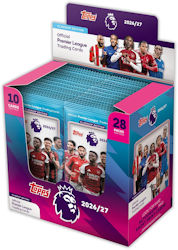
Topps Flagship Premier League 2026/27 Trading Cards Full Box
The Full Box contains 28 packets (10 cards per packet). Each box delivers the full Topps Flagship Premier League 2026/27 collecting experience, packed with stars, rookies, rare inserts, and exciting hits.
View product
As an Amazon Associate I earn from qualifying purchases.